
For education only. This review summarizes published research and is not medical advice; speak with your own clinician about your situation.
This 2013 study by Drake et. al (1), is where the common advice to stop caffeine six hours before bed comes from. It is a cornerstone of sleep research, but it was small and is now more than a decade old, so this review covers both what it found and what newer, larger studies have added since.
The bottom line
A single 400 mg dose of caffeine (about four 8-oz cups of brewed coffee) cost healthy adults more than an hour of sleep, whether they took it at bedtime, three hours before bed, or six hours before bed. The six-hour result is why this 2013 study is cited so often. It was the first controlled trial to give the same dose at different times before sleep, and it moved the advice from "don't drink coffee at night" to "your mid-afternoon coffee counts too."
Two other findings matter for patients. When caffeine was taken six hours before bed, participants largely didn't notice the damage it was causing: their sleep diaries showed only a small change in how well they felt they slept, while the brain-wave (EEG) headband recorded about 70 minutes of lost sleep. Interestingly, caffeine reduced non-REM sleep, both light and deep (slow-wave) sleep, while largely leaving REM sleep intact.
What the study did
Drake and colleagues at the Henry Ford Sleep Disorders and Research Center enrolled 12 healthy normal sleepers (6 women, 6 men, aged 19 to 48, mean age 29). Participants were screened for insomnia, sleep apnea risk and depression. All were regular caffeine users, averaging about 115 mg a day at baseline (just over a coffee a day on average).
The study was randomized, double-blind and placebo-controlled, with a crossover design: every participant went through every condition, so each person served as their own comparison.
Four study nights per person: 400 mg of caffeine in pill form taken 6 hours before, 3 hours before, or right at their usual bedtime, plus one night with only placebo (dummy) pills.
Blinding: every study day, participants took three pills (at 6 hours, 3 hours and bedtime). Only one contained caffeine, so nobody knew which condition they were in.
Washout nights: a night with no study pills and no monitoring separated each study night, so effects wouldn't carry over.
Background caffeine: participants could have their usual caffeine until 4 pm to avoid withdrawal symptoms, and the amount was similar across conditions (roughly 125 to 155 mg a day).
Sleep was measured two ways at home: a standard sleep diary each morning to capture how participants felt they slept, and the Zeo, a headband that records brain waves (EEG) from the forehead to estimate time asleep and sleep stages. The headband is less detailed than an overnight sleep-lab study, but far more objective than a diary.
What they found
When measured by the headband EEG, caffeine at every time point (0, 3 and 6 hours before bed) cut total sleep by 65 to 71 minutes and dropped sleep efficiency from 91% to about 83%. (Sleep efficiency is the share of time in bed actually spent asleep.) The six-hour dose was not milder; on paper it produced the largest loss of total sleep and of deep sleep. The differences between the three timings were small enough that they could be due to chance.
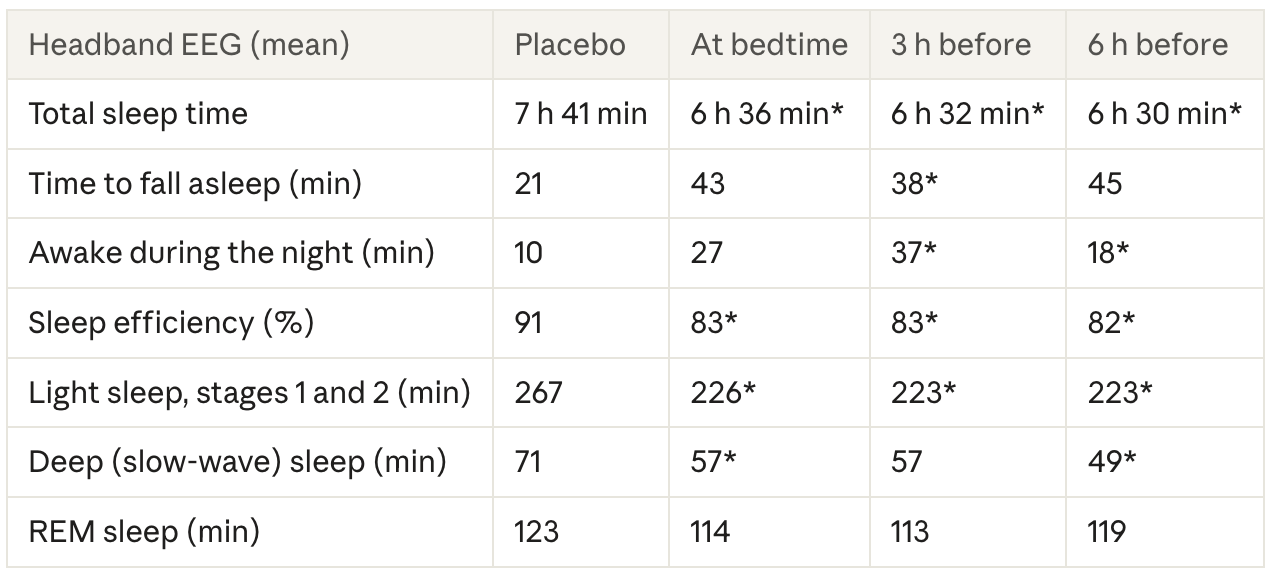
*Statistically significant difference from placebo, meaning it is unlikely to be due to chance. Values from Table 3 and the results text of Drake et al. (2013).
The sleep diaries told a softer story. Caffeine at bedtime and 3 hours before bed significantly shortened reported sleep (by about 54 and 63 minutes), and the 3-hour dose tripled reported time to fall asleep (21 to 63 minutes). At 6 hours, participants reported 41 minutes less sleep and took twice as long to fall asleep, but with only 12 people these changes fell just short of statistical significance. Rated sleep quality did not change in any condition.
The authors flag this gap between measured and perceived sleep as a key finding. Caffeine tends to break sleep up with short awakenings, and those are easy to sleep through and forget. That may be one reason people keep drinking afternoon coffee: they don't feel the cost.
The ASCENT Angle
A small study with big error bars
Twelve participants is a small sample, and the authors acknowledge it limited the study's statistical power (its ability to detect real effects), particularly for the diary measures. Another issue is that the spread in the data is wide. Measured time to fall asleep after the 6-hour dose averaged 45 minutes, but some people fell asleep quickly while others took far longer, so only large, consistent effects could reach statistical significance. This is partly a problem with testing caffeine's effect on sleep, because people metabolize (break down) caffeine at very different rates, and some people are more sensitive sleepers than others. Add the two together and you are going to get some people affected a lot, and some who don't see a huge change. This is not a limitation of the paper, just a natural outcome of individual differences in physiology. It means that just because your friend can have an after-dinner cappuccino doesn't mean you can.
It is also important to be precise about which effects missed statistical significance, and to think about whether that reflects a limitation of the study's methods or a true lack of effect. On the headband EEG, the 6-hour dose did reach significance for total sleep, time awake during the night, sleep efficiency, light sleep and deep sleep. The 6-hour results that fell short were the self-reported ones (41 fewer minutes of sleep and twice as long to fall asleep) and measured time to fall asleep (24 minutes longer). Those are meaningful changes to anyone's night, sitting just outside the cut-off for statistical significance. A larger sample would very likely have confirmed them, and later work has: a 2025 study with nearly twice as many participants, using more complete at-home sleep recordings (polysomnography, the type of monitoring used in sleep labs), found a 400 mg dose disrupted sleep even when taken 12 hours before bed (Gardiner et al., 2025).
The small sample cuts the other way too. The study found no significant differences between the three caffeine timings, but with only 12 people, that doesn't show 6 hours is as bad as bedtime; the study simply couldn't tell them apart. The larger 2025 trial did find a gradient, with sleep disruption increasing the closer to bedtime the caffeine was taken.
Three other limits are worth stating. The Zeo headband tends to miss brief awakenings, so time awake during the night was probably underestimated. And its sleep-stage measurements were a secondary, exploratory part of the study, so they show a direction rather than precise numbers. Finally, the study was funded by Zeo Inc., the company that made the headband. That doesn't make the results wrong, but it is worth knowing when a device maker pays for a study that uses its own device.
Why 3 hours may hit harder than bedtime
Several numbers point to 3 hours before bed as the worst timing. It produced the largest self-reported sleep loss (63 minutes) and the biggest jump in self-reported time to fall asleep (21 to 63 minutes). It was the only timing that significantly lengthened measured time to fall asleep, and it produced the most measured wake during the night (37 minutes, versus 10 on placebo).
How the body absorbs and clears caffeine offers a plausible explanation. Caffeine taken by mouth reaches its peak level in the blood anywhere from 15 to 120 minutes later. Taken at bedtime, caffeine is still being absorbed as the person lies down, and the strong sleep drive built up over the day may carry them into sleep before the full effect arrives. Taken 3 hours earlier, caffeine is near its peak through lights-out and the first sleep cycles, exactly when the brain is trying to fall asleep and build deep sleep. A 2023 analysis pooling 24 studies likewise found caffeine's effect on time to fall asleep peaked about 3 hours after intake (Gardiner et al., 2023).
Two cautions keep this from being a firm rule. The differences between timings were small enough to be due to chance. And on the headband EEG, the 6-hour dose actually produced the largest losses of total sleep (71 minutes) and deep sleep (22 minutes).
Part of the reason is simple arithmetic. Caffeine's half-life, the time it takes the body to clear half of a dose, is typically about 5 hours. So 400 mg taken 6 hours before bed still leaves roughly 175 mg circulating at lights-out, more than a standard cup of coffee. Half-life varies from about 1.5 to 9.5 hours between people, and for someone at the slow end, closer to 260 mg would remain. The 6-hour dose also landed between roughly 3 and 7 pm, potentially on top of participants' own afternoon caffeine, which was allowed until 4 pm.
The practical message is that, for a large dose, there is no safe window within 6 hours of bed. Dose and how quickly your body clears caffeine matter more than the exact hour.
400 mg is not a typical cup
The study counted an 8-oz cup of home-brewed coffee as 100 mg, so the test dose equals about four cups taken at once, which is also the upper daily limit recommended for healthy adults. These results are close to a worst case for a single serving.
Newer data support the idea that a bigger dose means a bigger effect. In the 2025 Gardiner trial, 100 mg (about one cup of coffee) had no significant effect on measured or self-reported sleep, even when taken 4 hours before bed. The 400 mg dose cut deep sleep by about 21 minutes and delayed falling asleep even when taken 12 hours before bed. Within 8 hours of bed it also added nearly half an hour of time awake during the night, and at 4 hours it cost about 50 minutes of total sleep and cut participants' rating of their sleep quality by about a third.
"Less severe at 100 mg" still isn't "no effect." There have been differing messages depending on the study and what it found in its participants. For example, the 2023 meta-analysis by Gardiner (a study that pools the results of many earlier studies) made a more conservative recommendation: it estimated that a 107 mg coffee should be finished at least 8.8 hours before bed, and a 218 mg pre-workout serving at least 13.2 hours before, to avoid losing sleep. And many people's "one coffee" isn't 100 mg. Drake and colleagues note that a 16-oz brewed coffee can contain up to 500 mg. The type of bean matters most (robusta beans carry roughly twice the caffeine of arabica), along with how strongly the coffee is brewed; studies comparing light, medium and dark roasts have generally found little difference (Olechno et al., 2021).
Why deep sleep took the hit and REM didn't
A quick primer on sleep stages. Through the night, sleep cycles between two broad types roughly every 90 minutes. Non-REM sleep includes light sleep (stages 1 and 2) and deep sleep (stage 3, also called slow-wave sleep after the large, slow brain waves that define it). REM (rapid eye movement) sleep is the stage most associated with vivid dreaming. Deep sleep is concentrated in the first few hours of the night, while REM periods grow longer toward morning.
In this study, caffeine cut deep sleep by 14 to 22 minutes (a 20 to 32% drop) and light sleep by about 40 minutes. REM sleep stayed within 11 minutes of placebo at every timing, a difference small enough to be due to chance. Because total sleep shrank while REM held steady, REM actually made up a slightly larger share of the night. A 2023 review of 24 studies found the same overall pattern: caffeine shifts the night toward lighter sleep and away from deep sleep.
So why would caffeine single out deep sleep? Three explanations likely work together.
1. Caffeine blocks the brain's "sleep pressure" signal. While you are awake, a molecule called adenosine gradually builds up in the brain. The more adenosine accumulates, the sleepier you feel, and the more deep sleep your brain produces once you fall asleep. Deep sleep is largely how the brain pays off that built-up pressure. Caffeine works by blocking the receptors adenosine acts on, so with caffeine on board the brain registers less sleep pressure than is really there and produces less deep sleep.
This is the best-established explanation. Research from Hans-Peter Landolt's group at the University of Zurich has shown that caffeine blunts the brain-wave markers of sleep pressure. Their work also shows that common variations in an adenosine receptor gene help explain why some people sleep fine after an evening coffee while others lie awake. REM sleep is controlled by different brain circuits and by the body's internal clock rather than by adenosine, so it is largely spared.
2. Caffeine pushes the nervous system toward "fight or flight." The autonomic nervous system runs the body's automatic functions, such as heart rate, blood pressure and digestion. It has two arms. The sympathetic arm ("fight or flight") speeds things up, raising heart rate and blood pressure. The parasympathetic arm ("rest and digest") slows things down.
Each sleep stage has its own balance between the two. Deep sleep is the most parasympathetic stretch of the entire 24-hour day: heart rate and blood pressure reach their lowest points, and heart rate variability, a marker of parasympathetic activity, rises. REM sleep is different. During REM the nervous system swings toward the sympathetic side, with bursts of higher heart rate and blood pressure that look more like wakefulness.
Caffeine stimulates the sympathetic side. Drake and colleagues point to an earlier study in which 400 mg taken 30 minutes before bed changed heart rhythm patterns during sleep in a way consistent with increased sympathetic activity. A body nudged toward "fight or flight" has a harder time settling into the deeply parasympathetic state that deep sleep requires. REM, which already runs closer to the sympathetic side, is less disturbed.
3. Timing within the night. Deep sleep is front-loaded into the first few hours after falling asleep, when caffeine levels in the blood are highest. REM is concentrated in the last few hours, after the body has had more time to clear caffeine. Even if caffeine affected both stages equally, deep sleep would take more of the hit.
REM is not completely immune. Most of this evidence comes from single-night studies, and daily use tells a more mixed story. In one Swiss study, young men who were already heavy coffee drinkers (about 480 mg a day) took 150 mg three times a day for 10 days. Their regular overnight sleep looked no different from placebo, which suggests the body partly adapts to a daily habit (Weibel et al., 2021a). But in a separate sleep session timed for the early-morning hours, when REM normally peaks, their first REM period arrived later and they reported feeling more tired on waking (Weibel et al., 2021b). An observational study of 98 teenagers also linked evening caffeine to less REM sleep (Lunsford-Avery et al., 2022). REM is less affected than deep sleep, but not untouched.
What losing deep sleep costs
A 14 to 22 minute nightly loss matters more than it sounds. Healthy young adults get roughly 80 to 100 minutes of deep sleep a night, while most adults over 60 get less than 20. Much of what we know about deep sleep's functions comes from experiments that suppressed it far more aggressively than caffeine does, so these findings show the direction of the risk rather than its size.
Glucose regulation. Suppressing deep sleep by about 90% for three nights, without shortening total sleep, cut insulin sensitivity by about 25% in healthy young adults. (Insulin sensitivity is how well the body responds to insulin, the hormone that moves sugar out of the blood.) The body did not release more insulin to compensate, and the bigger the loss of deep sleep, the bigger the drop (Tasali et al., 2008).
Brain waste handling. One night of disrupted deep sleep raised levels of amyloid-beta, the protein that forms plaques in Alzheimer's disease, in the fluid around the brain and spinal cord the next morning. The rise was tied to the loss of slow brain waves specifically, not to total sleep time (Ju et al., 2017). Brain imaging shows the slow waves of deep sleep drive rhythmic pulses of this fluid through the brain, a likely route for clearing metabolic waste (Fultz et al., 2019). Ju's group suspects the amyloid rise reflects the brain making more of it rather than clearing less, so the mechanism is still being worked out.
Physical recovery. The largest nightly release of growth hormone, which supports tissue repair, typically arrives with the first deep-sleep episodes. Deep sleep is also the lowest point of the 24-hour day for heart rate and blood pressure, a nightly downshift that matters for athletes and for people with cardiovascular risk.
Memory. The slow brain waves of deep sleep help lock in newly learned information.
Two caveats apply. The deep-sleep data here came from a forehead headband and were exploratory. And no study has shown that habitual afternoon coffee causes diabetes or dementia through this pathway. The concern is more practical: the loss is invisible to the person, and lighter, shorter sleep can feed a cycle of daytime fatigue and more caffeine.
Practical advice for patients
Set the cutoff by dose, not just the clock. For a standard cup (about 100 mg), finish at least 8 hours before bed if sleep is a concern. If you are quite caffeine tolerant, that can likely be closer to 6 hours. Keep 200 mg or more (a large café coffee, energy drink or pre-workout) to the morning, about 12 hours before bed. With a 10:30 pm bedtime, that means a regular coffee by about 2:30 pm and larger doses by about 10:30 am.
Don't rely on "it doesn't affect me." Both Drake and Gardiner found people underestimate caffeine's effect on their sleep. A two-week experiment is more informative: move the last caffeine to before noon, track time to fall asleep, night wakings and morning grogginess with a diary or wearable, and compare.
Count the real dose. Check café sizes, cold brew, energy drinks, pre-workout products, strong tea and some over-the-counter pain relievers. Total intake across the day matters, not just the last cup.
Move the cutoff earlier if you clear caffeine slowly or are a sensitive sleeper. Oral contraceptives can double caffeine's half-life, it can reach about 16 hours in late pregnancy, and some medications slow its clearance sharply. People with insomnia, anxiety or a long-standing "one coffee keeps me up" history are likely more sensitive, partly for genetic reasons.
Replace the afternoon dose instead of just removing it. A 10 to 20 minute nap before mid-afternoon, a walk outside in daylight, or decaf or half-caf can cover the slump without the sleep cost.
Reassess if sleep doesn't improve. If sleep onset or night waking is still poor after two to four weeks with an early cutoff, caffeine probably isn't the main driver, and it's worth looking for other causes with your clinician.
If you enjoyed this research review and want to see more, please subscribe to the mailing list below and we will send every new review directly to your inbox!
References
Drake C, Roehrs T, Shambroom J, Roth T. Caffeine effects on sleep taken 0, 3, or 6 hours before going to bed. J Clin Sleep Med. 2013;9(11):1195–1200.
Gardiner C, Weakley J, Burke LM, et al. The effect of caffeine on subsequent sleep: a systematic review and meta-analysis. Sleep Med Rev. 2023;69:101764.
Gardiner CL, Weakley J, Burke LM, et al. Dose and timing effects of caffeine on subsequent sleep: a randomized clinical crossover trial. Sleep. 2025;48(4):zsae230 (published online October 2024).
Tasali E, Leproult R, Ehrmann DA, Van Cauter E. Slow-wave sleep and the risk of type 2 diabetes in humans. PNAS. 2008;105(3):1044–1049. See also the University of Chicago release for deep-sleep norms by age.
Ju YS, Ooms SJ, Sutphen C, et al. Slow wave sleep disruption increases cerebrospinal fluid amyloid-β levels. Brain. 2017;140(8):2104–2111.
Fultz NE, Bonmassar G, Setsompop K, et al. Coupled electrophysiological, hemodynamic, and cerebrospinal fluid oscillations in human sleep. Science. 2019;366(6465):628–631.
Landolt HP. "No thanks, coffee keeps me awake": individual caffeine sensitivity depends on ADORA2A genotype. Sleep. 2012;35(7):899–900.
Weibel J, Lin YS, Landolt HP, et al. The impact of daily caffeine intake on nighttime sleep in young adult men. Sci Rep. 2021;11(1):4668. (Weibel et al., 2021a)
Weibel J, Lin YS, Landolt HP, et al. Regular caffeine intake delays REM sleep promotion and attenuates sleep quality in healthy men. J Biol Rhythms. 2021;36(4):384–394. (Weibel et al., 2021b)
Lunsford-Avery JR, Kollins SH, Kansagra S, Wang KW, Engelhard MM. Impact of daily caffeine intake and timing on electroencephalogram-measured sleep in adolescents. J Clin Sleep Med. 2022;18(3):877–884.
Boudreau P, Yeh WH, Dumont GA, Boivin DB. Circadian variation of heart rate variability across sleep stages. Sleep. 2013;36(12):1919–1928.
Olechno E, Puścion-Jakubik A, Zujko ME, Socha K. Influence of various factors on caffeine content in coffee brews. Foods. 2021;10(6):1208.
Institute of Medicine. Caffeine for the Sustainment of Mental Task Performance: pharmacology of caffeine. National Academies Press; 2001.
European Food Safety Authority. Scientific opinion on the safety of caffeine: pharmacokinetics. 2015.
Grzegorzewski J, Bartsch F, Köller A, König M. Pharmacokinetics of caffeine: a systematic analysis of reported data. Front Pharmacol. 2022;12:752826.