
What We Measure · VO2max
The Decline You Can’t Feel
Ask someone how fit they are and they will usually tell you how they feel. They walk most days. They play a little tennis. They don’t get out of breath carrying the shopping in from the car. By that measure, nearly everyone at 55 is fine.
Feeling fine and being fit are different things, though, and the gap between them stays invisible for years. By the time it shows, a good deal of the margin is already gone.
Dr. Steven Murray · Founder and Clinical Director · 6 min read
VO2max is the maximum amount of oxygen your body can take in and use during hard effort. It is measured in millilitres of oxygen per kilogram of body weight per minute, and it reflects how well your heart, lungs, blood and muscles work together. It is also one of the strongest predictors of how long people live.
In a study of more than 122,000 adults who completed treadmill testing at the Cleveland Clinic, smoking raised the risk of death during follow-up by about 40%. Low fitness carried a larger risk than smoking did. People in the least-fit quarter for their age and sex had almost twice the risk of those in the group just above them, and about five times the risk of the fittest (1). Put another way, the gap between low fitness and merely below-average fitness was larger than the gap between smoking and not smoking.
A study of 750,000 US veterans found the same pattern in every age group, in men and women alike: the least fit carried approximately four times the mortality risk compared to the most fit (2).
Those are statistics about populations. The question that matters to you is narrower: what does this number mean for the life you want to keep living?
VO2max: The number
Risk of death during follow-up
Cleveland Clinic, more than 122,000 adults
Smoking
Smokers compared to non-smokers
1.41 x
Low fitness
Least-fit quarter compared to just below average.
1.95 x
Low fitness
Least-fit quarter compared to most fit 10%.
5.04 x
Adjusted hazard ratios, Mandsager et al., 2018. (1)
Everything you do has an oxygen cost
Every activity demands a certain amount of oxygen. A walk on level ground asks for very little. A flight of stairs or a walk up a hill asks for about 19 mL/kg/min. A hard game of singles tennis or a long swim asks for about 26 (3).
Your VO2max is your ceiling. When the ceiling sits well above what an activity costs, the activity feels easy. As the ceiling comes down toward that cost, the activity takes more of what you have, until it takes all of it.
What it asks of you
A walk on level ground
Very little
A flight of stairs, a walk up a hill
About 19 mL/kg/min
Competitive singles tennis, a long swim
About 26 mL/kg/min
Duke Activity Status Index, converted at 1 MET = 3.5 mL/kg/min.3
People rarely decide to stop climbing stairs. They begin taking the lift because the stairs have become hard, and the stairs become harder because they are no longer climbing them.
The ceiling comes down, and the descent speeds up
VO2max falls with age. The Baltimore Longitudinal Study of Aging tested the same adults repeatedly over many years and found that the rate of decline rose from 3–6% per decade in the 20s and 30s to more than 20% per decade from the 70s onward. It happened whether or not people exercised. Active people declined too. They started higher, so they stayed higher (3).
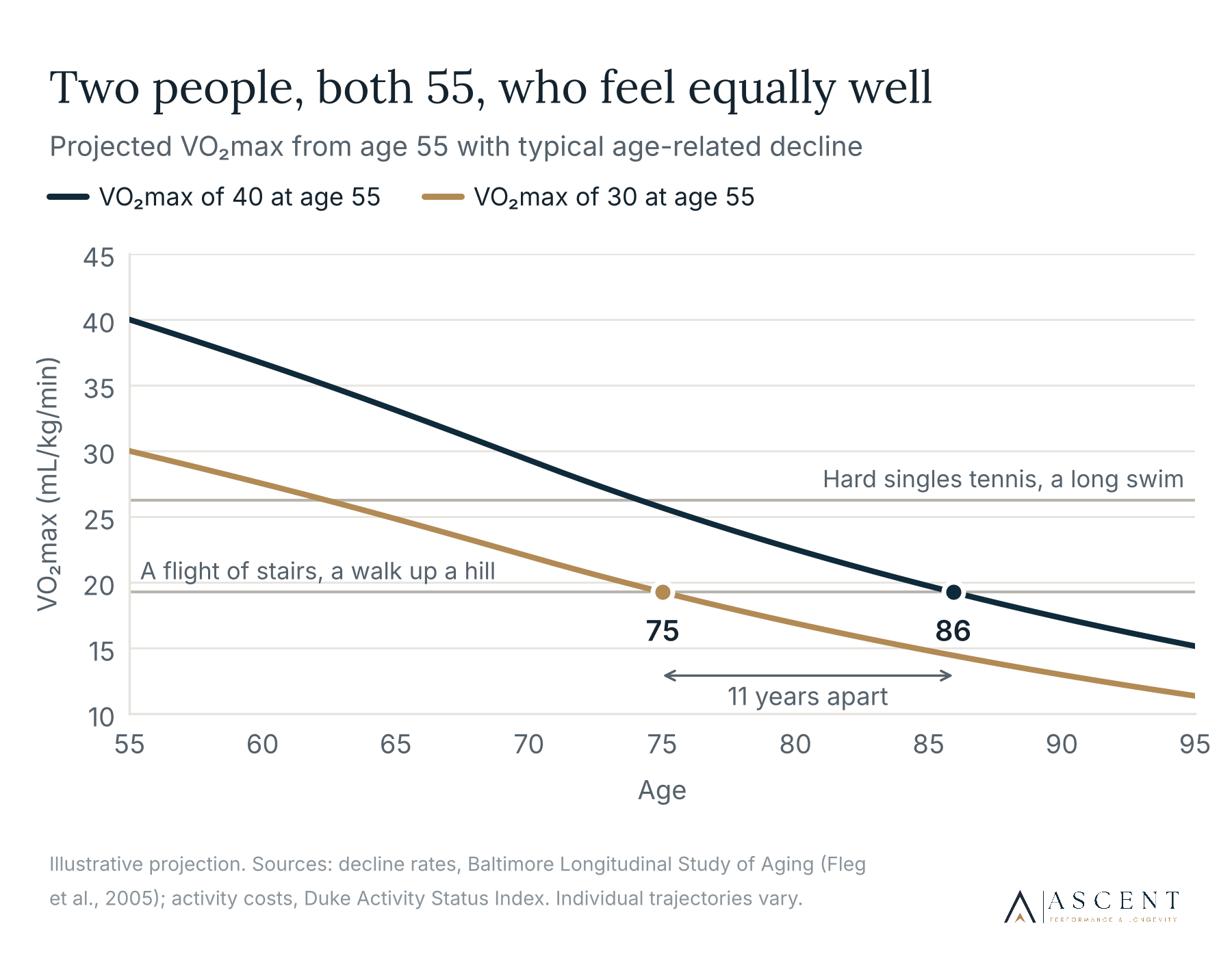
Consider two people, both 55. Both feel well. Both walk regularly and would describe themselves as reasonably fit. One has a VO2max of 30, close to average for their age. The other has a VO2max of 40, well above it.
Project both people forward at the rates measured in that study and the difference stops being abstract. For the first person, a hard game of singles tennis becomes an all-out effort in their early 60s. By about 75, a single flight of stairs takes everything they have. The second person doesn’t reach the same same point at about 86.
Two or three years past that point sits the level researchers associate with losing independence: roughly 18 mL/kg/min for men and 15 for women (5). Women start from a lower number and decline a little more gradually, but the shape of the curve is the same.
Today, these two people feel the same…
Neither of them knows which line they are on.
Feeling fine isn’t a measurement
It isn’t part of routine care
A standard check-up measures blood pressure, cholesterol and blood sugar. It doesn’t measure how well your heart, lungs and muscles work together under load.
Why you don’t know your number
The watch number is an estimate
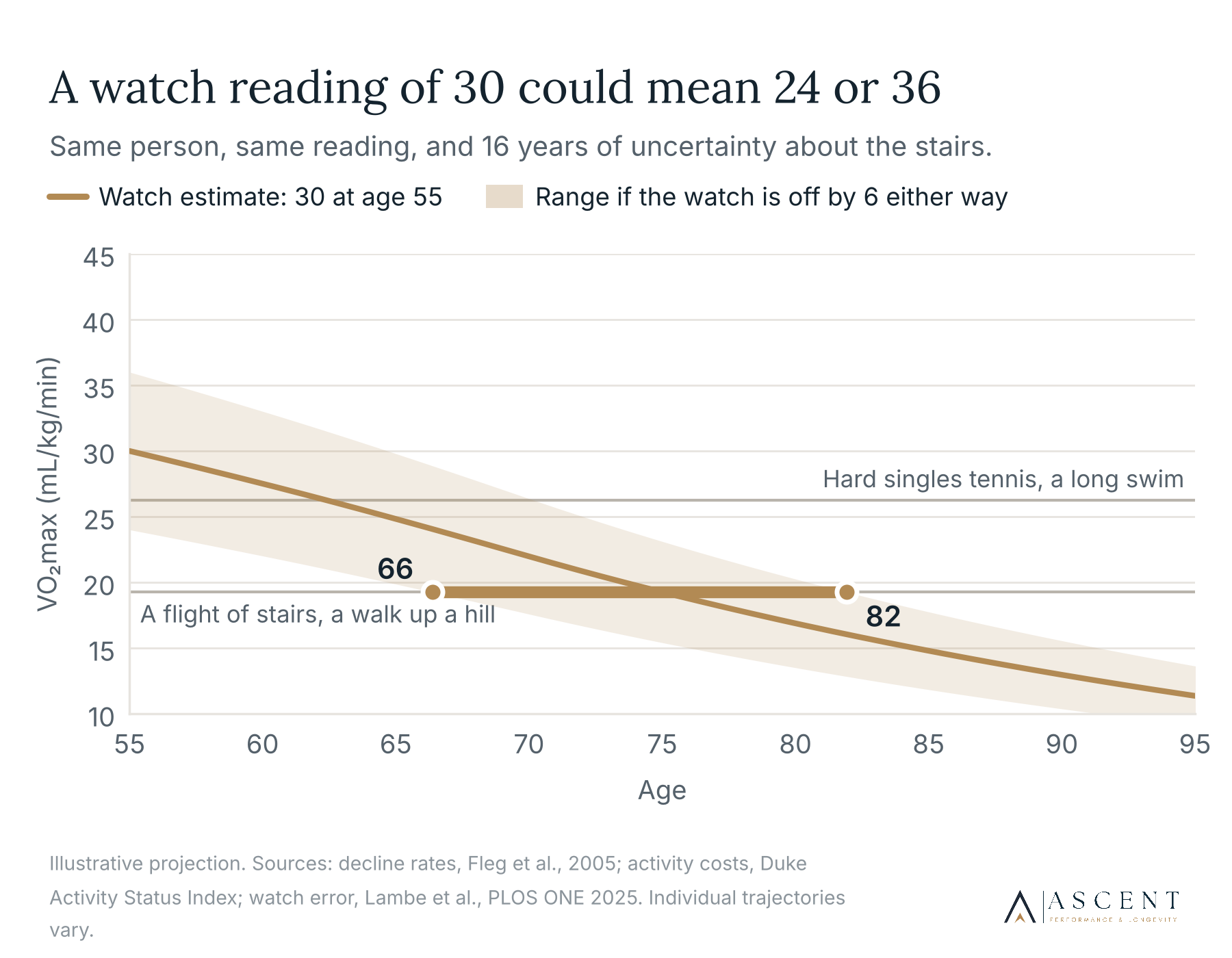
In a 2025 validation study, Apple Watch estimates of VO2max ran about 6 mL/kg/min below laboratory measurements on average, and for most individuals the error fell somewhere between about 6 points too high and 18 points too low (6)
Decline never announces itself
Nothing tells you when your VO2max moves from 30 to 25. You find out when your ceiling meets something you want to do.
For the person whose watch reads 30, a six-point error in either direction moves the age at which stairs take everything they have anywhere from 66 to 82. That is the difference between planning for your late 60s and planning for your 80s, and your watch cannot tell you which one you are planning for.
The curve can move
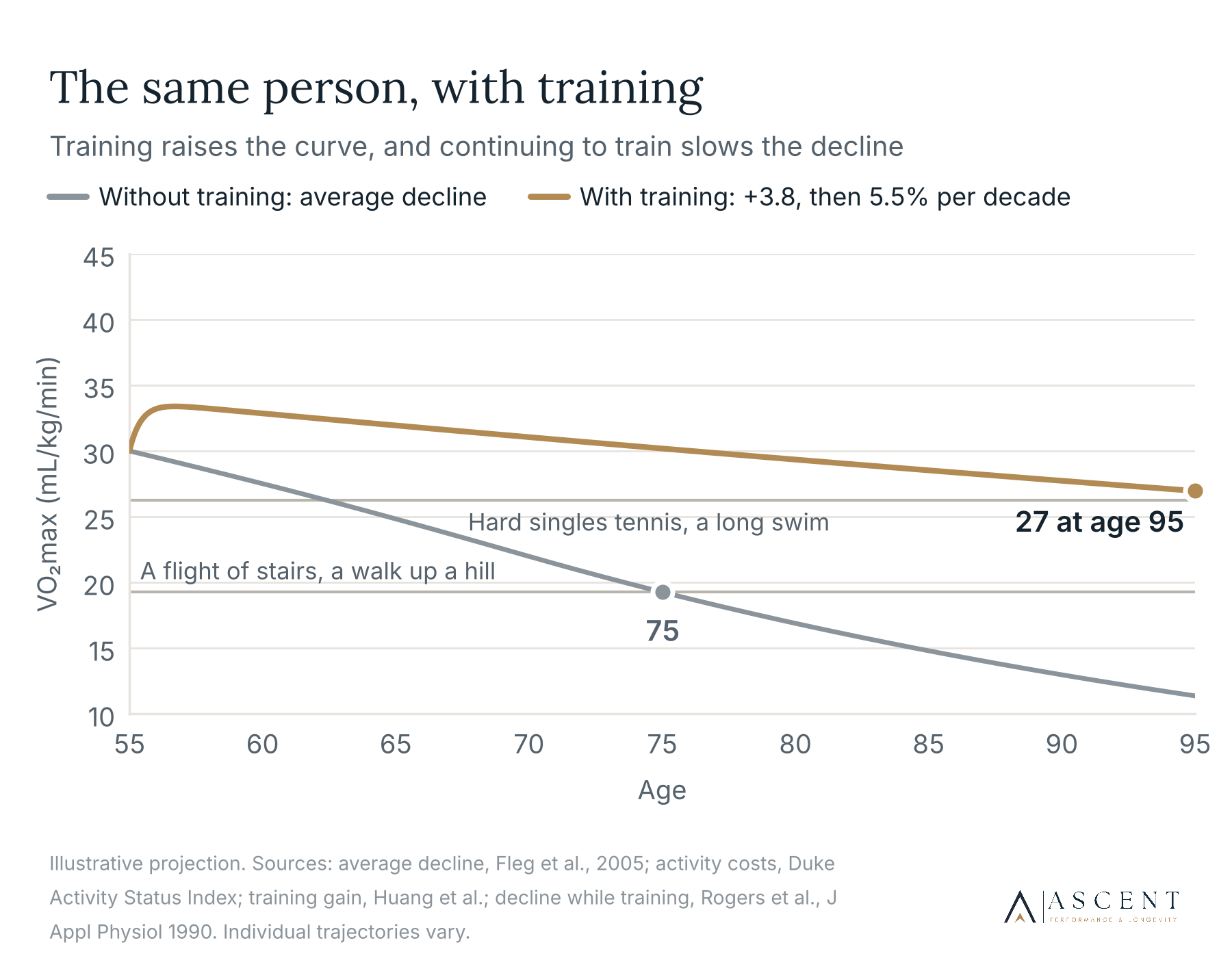
VO2max responds to training at any age. In controlled trials of previously sedentary older adults, endurance training raised VO2max by an average of almost 4 mL/kg/min (7). Men and women in their 70s have improved by more than 20% over six months of structured training (8).
Continuing to train changes the slope as well. In a study that followed men of about 60 over eight years, those who kept training lost about 5.5% of their VO2max per decade. Sedentary men of the same age lost about 12% (9).
Put the two effects together for the person at 30. Without training, they follow the average curve and a flight of stairs takes maximal effort at about age 75. The first-year gain on its own moves that to about 80. If they keep training, and their decline slows to 5–6% per decade, they are still at about 27 at age 95, well above what a flight of stairs asks of them.
The benefit lasts as long as the training does. Stop, and the curve bends back toward where it was heading. This is why VO2max is not an eight-week project. It is a number to be measured, acted on, retested and adjusted, year after year.
Every Ascent member’s VO2max is measured directly, from the air they breathe during a graded exercise test, rather than estimated. The result is not filed away. It is set against what the member wants to keep doing (the hike, the tennis, the grandchildren, the stairs at home) and turned into a plan with specific targets. It is retested once or twice a year, depending on the member’s goals, and the plan changes with it.
Over time the measurement becomes more useful than any single number. It becomes a trajectory specific to you, with a clinician responsible for bending it.
VO2max is the first of several measures Ascent tracks over years. Strength, muscle and balance follow the same pattern: each declines quietly, each matters more than it seems, and each responds when someone is paying attention.
What we do at Ascent
For every member
Measured directly
From your breath, during a graded exercise test.
01
Set against your life demands
The hike, the tennis, the grandchildren, the stairs at home.
02
Turned into a plan
With specific workouts and targets
03
Retested
Once or twice a year, and the plan is updated based on progress.
04
Dr. Steven Murray
Founder and Clinical Director, Ascent
Sources
Mandsager K, Harb S, Cremer P, et al. Association of cardiorespiratory fitness with long-term mortality among adults undergoing exercise treadmill testing. JAMA Network Open. 2018;1(6):e183605.
Kokkinos P, et al. Cardiorespiratory fitness and mortality risk across the spectra of age, race, and sex. Journal of the American College of Cardiology. 2022;80(6):598–609.
Hlatky MA, Boineau RE, Higginbotham MB, et al. A brief self-administered questionnaire to determine functional capacity (the Duke Activity Status Index). American Journal of Cardiology. 1989;64(10):651–654. Activity costs converted at 1 MET = 3.5 mL/kg/min.
Fleg JL, Morrell CH, Bos AG, et al. Accelerated longitudinal decline of aerobic capacity in healthy older adults. Circulation. 2005;112(5):674–682.
Shephard RJ. Maximal oxygen intake and independence in old age. British Journal of Sports Medicine. 2009;43(5):342–346.
Lambe R, O’Grady B, Baldwin M, Doherty C. Investigating the accuracy of Apple Watch VO2 max measurements: a validation study. PLOS ONE. 2025;20(5):e0323741.
Huang G, Wang R, Chen P, et al. Dose–response relationship of cardiorespiratory fitness adaptation to controlled endurance training in sedentary older adults. European Journal of Preventive Cardiology. 2016;23(5):518–529.
Hagberg JM, Graves JE, Limacher M, et al. Cardiovascular responses of 70- to 79-yr-old men and women to exercise training. Journal of Applied Physiology. 1989;66(6):2589–2594.
Rogers MA, Hagberg JM, Martin WH, Ehsani AA, Holloszy JO. Decline in VO2max with aging in master athletes and sedentary men. Journal of Applied Physiology. 1990;68(5):2195–2199.
Projections on this page are illustrative and apply the published average decline rates for men to two hypothetical starting points. Individual trajectories vary, which is why Ascent measures rather than estimates.
Ascent opens in Barbados in late 2028.
Updates on the property, the timeline and founding membership, directly from Dr. Murray.