
Nobody Is Tracking the Whole Picture: The story of ASCENT.

I want to start by telling you why this clinic exists, before I tell you anything about what it will look like.
For the last several years, I've worked with people trying to hold onto something or desperately trying to get it back — the ability to keep running, keep travelling, keep playing with their kids or grandkids, keep doing the things that make their lives feel like their own. Most of the time, the care available to them is built around episodes: something goes wrong, they get treated, and then they're on their own again until the next thing goes wrong. Care is often divided between doctors, specialists and therapists, each addressing one part of the problem within a limited window of time. Even when each individual clinician provides good care, the system rarely gives anyone responsibility for tracking the whole picture: how someone’s capacity is changing, what they are trying to preserve, and what needs attention before the next problem becomes acute.
That gap is what Ascent is being built to close.
The personal part
My wife was born and raised in Barbados. Her family (and now mine) is still there, and over the years it's become home to us too — enough that I have become a Barbadian citizen myself, and we're planning to move there permanently in 2028. Barbados also has exactly the conditions this kind of clinic is built for: an ageing population and a substantial burden of chronic disease, alongside a community that places considerable value on health, activity and quality of life. It's not a market I'm guessing at from the outside. It's a clinic to serve the place I'm going to call home.
Professionally, I'm a Doctor of Chiropractic with a Master's in Exercise Physiology and a CSEP High Performance Specialist designation — so my background sits at the intersection of musculoskeletal care, rehabilitation, and objective physical testing. Ascent is my attempt to build the kind of practice I think people actually need: a unified clinical team, a small number of members, and enough continuity to understand someone's history well enough to make good decisions with them over years, not single visits.
What Ascent will be
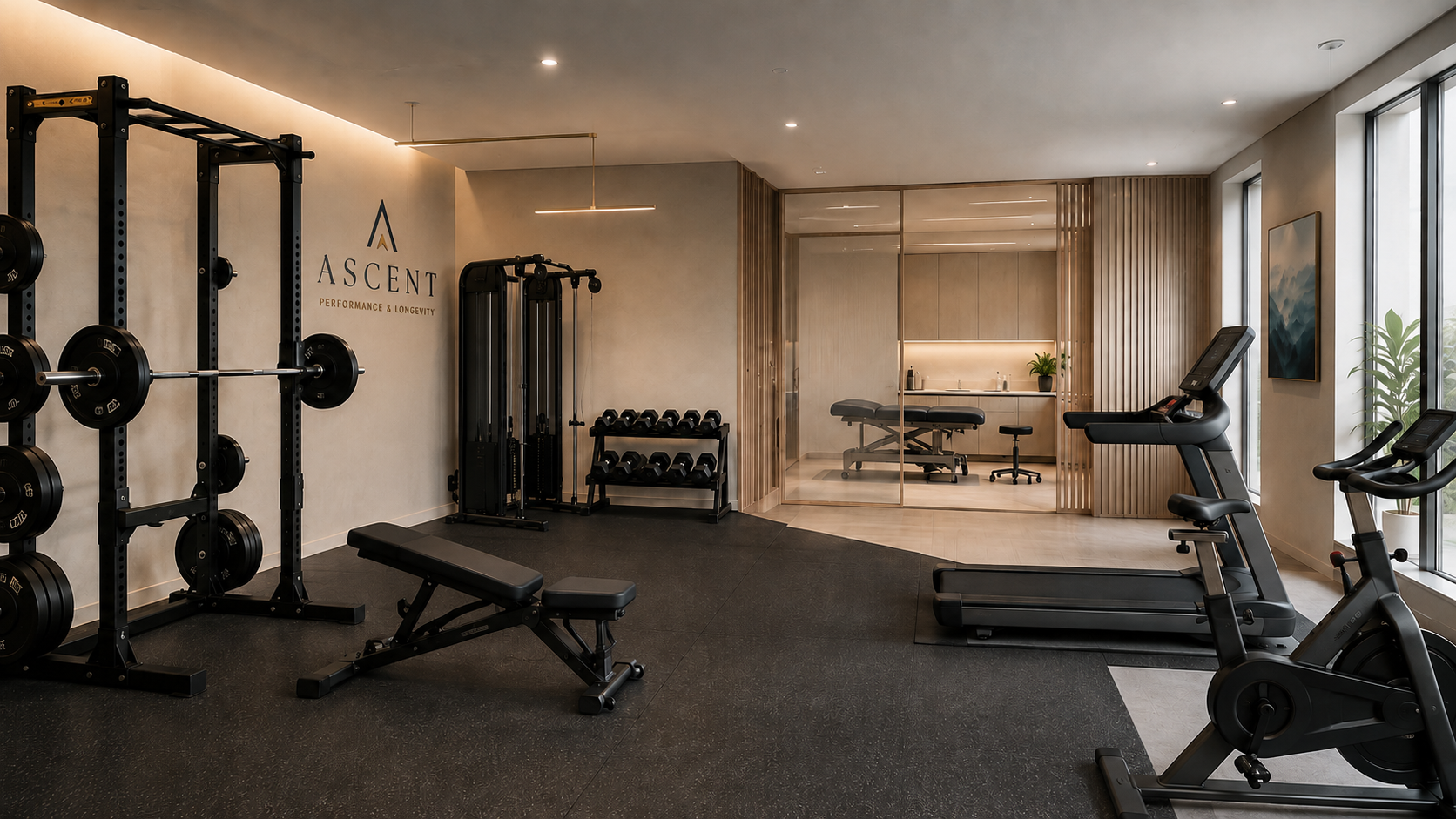
Ascent will be a limited-membership health, longevity and performance clinic. It will be kept deliberately small, so that care stays personal rather than becoming another high-volume practice. Members will get a real baseline assessment, movement analysis, regular access to both clinical and rehabilitation sessions, objective testing they can track over time, and a clinician who already knows each member’s history when they walk in. Not a spa. Not a gym. Not a concierge add-on. A clinical relationship built to last.
Care will be structured to evolve and grow as your life and goals do. Whether you are looking to improve your golf game, play tennis into your later years, go on a once-in-a-lifetime hiking trip in the Andes, or just stay active and healthy enough to teach your grandkids how to play cricket, care will be designed with you in mind. Your baseline, your injury history, your current capacity, and your life aspirations. No generalized exercise handouts. No generic treatment plans.
Why time with a clinician still matters
Today, a lot of people come into clinic with an interesting problem: they have more access to information than ever, but it is not changing how they are feeling or functioning. Everyone has tried something they heard on a podcast, something an AI put together for them, something a fitness account posted with confidence. None of that is necessarily wrong, and I don't think looking things up is a bad instinct. But generic advice, however well-written, doesn't know your injury history, your capacity, your daily demands, your fitness aspirations, or the way your knee has been behaving for six months. Even good information is limited by the quality and completeness of the context it receives. A podcast, search result or AI-generated plan cannot examine you, verify what you report, observe how your symptoms change under load, or assume responsibility for adjusting the plan over time.
It doesn't know you.
That's the piece I think gets lost. Clinical judgment isn't just information — it's years of training and experience contextualized and applied to one specific person, in a room, one-on-one, with enough time to actually look, ask, and reconsider. Ascent is built around the idea that there is no substitute for time.
When it comes to you and your health, time is the one thing that you cannot get back. I have seen it many times before in clinic — patients wishing they had tried something earlier, had known something earlier, or had spent the time to fix something correctly before it was too late.
Where things currently stand
I'd rather tell you honestly than dress it up in aspirational marketing jargon. Right now, Ascent doesn't have a property, and we haven't opened. We're targeting a late-2028 open, and that date will move to ensure things are done right rather than the other way around. What's happening right now is the not-so-glamorous but necessary work: figuring out exactly what prospective members actually need, building the relationships and the plan that will let this open successfully, and making sure every decision is grounded in what people actually want and need, not just what I assume they do.
That’s why I’ve chosen to open the mailing list first. I'm not building this in a vacuum, and I don't want to. If there's something about your own health, fitness, or recovery that you've been managing on your own, or something you wish someone was actually tracking with you over time, I'd genuinely like to hear about it. It's part of how Ascent gets shaped before a single door opens.
If you haven't already, you can sign up below to stay informed as this develops. I'll be sharing updates here as things get signed, decisions get made, and progress becomes concrete. No marketing. No gimmicks. No spam. JJust real updates, as they happen.
Dr. Steven Murray
Founder & Clinical Director, Ascent